

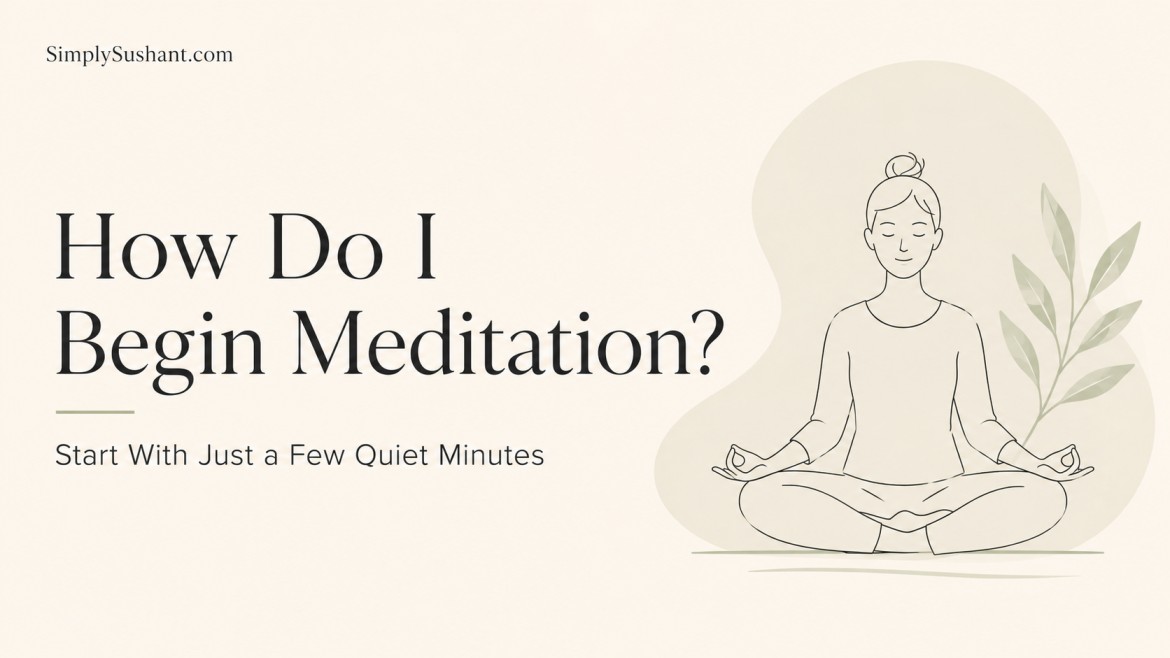
How Do I Begin Meditation? A Simple Guide for Starting Without Overthinking It
If you have ever asked yourself, “How do I begin meditation?”, there is a good chance you are already closer to starting than you think.
Meditation does not begin with perfect silence.
It does not begin with special clothes, incense, a dedicated room, or a completely calm mind.
It begins with a pause.
A few minutes.
A little attention.
And the willingness to notice what is happening inside and around you.
For beginners, the biggest mistake is often making meditation feel too complicated before even trying it. The simpler you keep the beginning, the easier it becomes to stay consistent.
First, Understand What Meditation Actually Is
Meditation is not about forcing your mind to stop thinking.
That is probably the most common misconception.
Your mind will think.
It will remember.
It will plan.
It will wander.
Meditation is the practice of noticing that movement without automatically following every thought.
You place your attention somewhere simple, usually on the breath.
Then your mind wanders.
You notice.
And you return.
That return is meditation.
How Do I Begin Meditation for the First Time?
Start with five minutes.
That is enough.
You do not need to begin with twenty or thirty minutes. In fact, shorter sessions are often better in the beginning because they feel manageable.
Here is a very simple way to start.
Step 1: Find a Comfortable Place
Choose somewhere you can sit quietly for a few minutes.
You can sit:
- on a chair
- on your bed
- on a cushion
- on the floor
- near a window
- on a sofa
There is no perfect meditation position.
Sit in a way that feels relaxed but alert.
Step 2: Set a Timer
Start with 3 to 5 minutes.
Using a timer helps because you do not have to keep wondering how long you have been sitting.
Once the timer is set, you can simply practice.
Step 3: Let Your Body Settle
Place your hands wherever they feel natural.
Relax your shoulders.
Unclench your jaw.
Let your face soften.
You do not need to force your body into a rigid posture.
The goal is comfort with a little alertness.
Step 4: Notice Your Breath
Now bring attention to your breathing.
Do not change it.
Do not try to breathe deeply unless that feels natural.
Just notice.
Feel the inhale.
Feel the exhale.
Notice where the breath is easiest to feel.
Maybe at the nose.
Maybe in the chest.
Maybe in the abdomen.
Stay with that sensation.
Step 5: Let the Mind Wander
It will.
You may suddenly think about:
work
money
a message
food
an old conversation
something you forgot
whether you are meditating properly
That is normal.
You do not need to stop the thought.
You only need to notice:
“My attention has moved.”
Then return to the breath.
Step 6: Keep Returning
This is the important part.
Your mind may wander ten times.
Return ten times.
It may wander fifty times.
Return fifty times.
You are not failing.
You are practicing attention.
Meditation is not about staying perfectly focused.
It is about becoming aware when you are not.
Step 7: End Slowly
When the timer finishes, take a few seconds before getting up.
Notice your body.
Notice the room.
Take one natural breath.
Open your eyes if they were closed.
Then continue with your day.
That is a complete meditation session.
A 5-Minute Meditation for Complete Beginners
If you want something easy to follow, try this:
Minute 1
Sit comfortably and settle your body.
Minute 2
Notice your breathing.
Minute 3
Keep returning to the breath when distracted.
Minute 4
Notice your body and any tension.
Minute 5
Notice the breath, your surroundings, and how you feel.
Then stop.
Simple.
No pressure.
What Should I Think About During Meditation?
You do not need to think about anything specific.
Meditation is usually more about noticing than thinking.
But if your mind needs something simple, you can use an anchor.
Good beginner anchors include:
- breathing
- counting breaths
- sounds
- body sensations
- a simple word
- a mantra
The anchor gives your attention somewhere to return.
What If I Cannot Stop Thinking?
You do not need to.
Thoughts are not the enemy.
They are part of the practice.
If you try too hard to stop thinking, you may create even more tension.
Instead, notice the thought.
You can quietly label it:
“thinking”
“planning”
“remembering”
“worrying”
Then return.
That is enough.
What Is the Best Meditation Technique for Beginners?
The easiest technique is usually simple breathing meditation.
But not everyone enjoys sitting still.
You can also try:
Breath counting
Count each exhale from one to ten, then start again.
Walking meditation
Walk slowly and notice each step.
Body scan meditation
Move your attention gradually through the body.
Guided meditation
Follow spoken instructions.
Sound meditation
Listen closely to sounds around you.
There is no need to try everything at once.
Pick one technique and stay with it for a few days.
How Long Should I Meditate as a Beginner?
Start small.
A sensible approach is:
Week 1: 3 to 5 minutes
Week 2: 5 to 7 minutes
Week 3: 7 to 10 minutes
After that, choose whatever feels sustainable.
You do not have to keep increasing the time.
A short daily meditation can be enough.
Should I Meditate in the Morning or at Night?
Both can work.
Morning meditation may help you start the day with more awareness.
Evening meditation can help you slow down after work.
The best time is the time you can repeat.
Consistency matters more than choosing the “perfect” hour.
What If I Feel Restless?
Restlessness is common.
Try this:
Keep the session shorter.
Sit in a chair.
Keep your eyes slightly open.
Try walking meditation.
Focus on physical sensations.
You do not need to force stillness.
Meditation should not feel like punishment.
What If Meditation Feels Boring?
That is also normal.
We are used to stimulation.
Phones.
Videos.
Messages.
Music.
Constant input.
Sitting quietly can feel strange at first.
Instead of fighting boredom, notice it.
What does boredom feel like?
Where do you feel it?
What does your mind want to do next?
Even boredom can become part of meditation.
Should I Use Music?
You can.
Some people prefer silence.
Others like soft instrumental music or nature sounds.
Guided meditation can also help beginners.
There is no strict rule.
Choose what makes it easier for you to practice regularly.
Do I Need a Meditation App?
No.
Apps can help with structure, timers, and guided sessions.
But they are not necessary.
You can begin with:
a chair
a timer
your breath
That is enough.
How Do I Make Meditation a Habit?
Attach it to something you already do.
For example:
After brushing your teeth → meditate.
After morning tea → meditate.
Before opening social media → meditate.
After coming home → meditate.
Before bed → meditate.
This makes meditation easier to remember.
Do Not Wait Until You Feel Calm
Many people think:
“I will meditate when my mind settles down.”
But meditation is often most useful precisely because the mind is busy.
You do not need to become calm before you begin.
You begin with the mind you have.
Restless.
Distracted.
Busy.
Imperfect.
That is enough.
A Simple 7-Day Beginner Meditation Plan
Day 1
Sit for 3 minutes and notice your breath.
Day 2
Meditate for 5 minutes.
Day 3
Try counting breaths.
Day 4
Try a short body scan.
Day 5
Try walking meditation.
Day 6
Use a guided meditation.
Day 7
Choose the method that felt easiest and repeat it.
At the end of the week, do not ask:
“Was I good at meditation?”
Ask:
“Which practice felt easiest to continue?”
That is a better question.
The Goal Is Not to Become Perfectly Peaceful
Meditation is not a promise that you will never feel stressed, angry, distracted, or anxious again.
Life will still happen.
Thoughts will still appear.
Emotions will still come.
The practice simply helps you notice them more clearly.
And sometimes that extra awareness creates a pause.
A pause before reacting.
A pause before overthinking.
A pause before following every thought.
That pause can be valuable.
Final Thoughts
So, how do you begin meditation?
You begin simply.
Sit somewhere comfortable.
Set a timer for a few minutes.
Notice your breathing.
Let your mind wander.
Notice when it does.
Return.
That is meditation.
You do not need special equipment.
You do not need perfect discipline.
You do not need to wait for the right moment.
You can begin today.
With one breath.
Then another.
And each time your mind drifts, simply come back.


