
We often assume that people fail to change because they lack motivation.
We know that exercising would improve our health. We understand that sleeping on time would make our mornings easier. We recognize that certain habits, relationships or thought patterns are holding us back.
We may even feel excited when we decide to change.
Yet a few days later, we find ourselves returning to the same familiar behaviour.
This can feel like a personal failure. We begin calling ourselves lazy, weak or undisciplined. But the truth is more interesting: your mind does not necessarily resist change because the change is bad. It often resists change simply because the change is unfamiliar.
The brain finds comfort in predictability. Even an uncomfortable routine can feel safer than an uncertain possibility.
Understanding this can completely change the way you approach personal growth.
The Familiar Can Feel Safer Than the Better
Imagine that you have been following the same route to work for several years. One morning, someone tells you about a faster route.
You may agree that the new route sounds better, but taking it still requires additional attention. You must watch for unfamiliar turns, read signs and remain conscious of where you are going.
The old route requires almost no thought.
Our habits work similarly.
Once a behaviour becomes familiar, the brain can perform it with less conscious effort. This is useful because it allows us to complete routine tasks without carefully analysing every movement.
But the same system can keep unhealthy patterns alive.
You may automatically reach for your phone whenever you feel bored. You may delay a difficult task because procrastination gives you temporary relief. You may remain silent during an important conversation because avoiding conflict has become your familiar response.
These actions may not serve you, but they are predictable—and predictability can feel like safety.
Your Mind Is Trying to Protect You
Resistance is not always an enemy. Sometimes it is an outdated form of protection.
Perhaps you avoid sharing your ideas because you were once criticized harshly. Maybe you find it difficult to trust people because trust previously led to disappointment. You might fear starting something new because an earlier failure caused embarrassment.
The mind learns from emotionally powerful experiences. It creates rules designed to prevent similar pain:
“Do not speak too openly.”
“Do not take unnecessary risks.”
“Do not expect too much.”
“Do not become emotionally dependent.”
These rules may have helped you survive a difficult period. But a protective response that was useful in the past can become a limitation in the present.
Personal growth often requires asking:
Is this fear protecting me from a real danger, or is it protecting me from an old memory?
The answer is not always obvious. But simply asking the question creates distance between you and the automatic response.
Why Motivation Usually Disappears
Motivation is powerful, but it is unreliable.
It often appears when we imagine the result of a change. We picture ourselves healthier, more confident, financially secure or emotionally peaceful. The image produces excitement.
But the actual process involves repetition, inconvenience and delayed rewards.
The idea of becoming fit is exciting. Exercising when you feel tired is not.
The idea of writing a book is inspiring. Sitting alone and writing an imperfect first page can feel uncomfortable.
The idea of building a business is thrilling. Handling routine paperwork, uncertainty and rejection is much less glamorous.
When motivation fades, the brain begins comparing immediate discomfort with a distant reward. Immediate comfort frequently wins.
This is why lasting change cannot depend entirely on how inspired you feel. It must be supported by a system that still works when inspiration is absent.
Start Smaller Than Your Ego Wants
When people decide to change, they often attempt a dramatic transformation.
They plan to wake up at 5 a.m., exercise for an hour, meditate, read, avoid sugar and complete all pending work—starting tomorrow.
The plan feels powerful because it creates the emotional experience of becoming a new person. But it demands too much change at once.
The mind interprets this as disruption. Resistance increases, the routine collapses and the person concludes that they lack discipline.
A more effective approach is to make the first step so small that resistance has little reason to appear.
Do not begin with an hour of exercise. Begin with ten minutes.
Do not promise to write an entire chapter. Write one paragraph.
Do not attempt to organize your whole life. Organize one drawer.
Do not try to meditate perfectly for thirty minutes. Sit quietly for two minutes.
A small action may not feel impressive, but it has one enormous advantage: you are more likely to repeat it.
Repetition teaches the brain that the new behaviour is safe. What initially feels unfamiliar gradually becomes normal.
Change Your Environment, Not Just Your Intentions
We often blame ourselves for habits that our surroundings constantly encourage.
If your phone remains beside you while you work, you must repeatedly resist checking it. If unhealthy food is always visible, you must make the healthy decision again and again. If your day has no defined structure, important tasks must compete with every possible distraction.
Willpower becomes exhausted when it must fight the same battle continuously.
A better environment reduces the number of battles.
Keep the phone in another room during focused work. Prepare your exercise clothes the previous night. Place a book where you usually keep the television remote. Remove unnecessary notifications. Decide in advance when and where you will perform the new habit.
These changes may appear ordinary, but they carry an important message: personal growth is not only about becoming mentally stronger. It is also about making desirable actions easier to perform.
Your Identity Influences Your Actions
There is a significant difference between saying, “I am trying to write,” and saying, “I am becoming a writer.”
The first statement focuses on an activity. The second begins shaping an identity.
Our behaviour is often guided by the type of person we believe ourselves to be. If you believe you are irresponsible, every mistake appears to confirm that identity. If you begin viewing yourself as someone who keeps small promises, each completed action strengthens a new self-image.
You do not need to claim an identity you have not earned. Build it through evidence.
Every time you walk despite not feeling motivated, you cast a vote for becoming an active person.
Every time you save a small amount, you cast a vote for becoming financially responsible.
Every time you respond calmly instead of reacting immediately, you cast a vote for becoming emotionally mature.
One action will not transform your identity. But repeated evidence eventually becomes difficult for the mind to ignore.
Expect Discomfort Without Treating It as a Warning
Change often feels uncomfortable before it feels natural.
This discomfort does not automatically mean you are making the wrong decision. It may simply mean that you are moving beyond a familiar pattern.
Speaking confidently may initially feel unnatural. Setting a boundary may create guilt. Resting without feeling productive may make you anxious. Asking for help may feel vulnerable.
The body can interpret unfamiliarity as danger.
When this happens, pause and remind yourself:
“This feels uncomfortable because it is new. I do not have to escape it immediately.”
Of course, genuine danger and harmful situations should never be ignored. But ordinary emotional discomfort is often part of learning.
Confidence is not always what allows you to begin. Sometimes confidence is what develops after you repeatedly act while feeling uncertain.
Do Not Turn One Bad Day Into an Identity
You will occasionally return to an old habit.
You may miss a workout, waste an afternoon, react emotionally or abandon your routine for several days. This does not erase your progress.
The real danger is the story you create afterwards:
“I knew I would fail.”
“I can never remain consistent.”
“There is no point in trying again.”
One imperfect day becomes evidence for an old identity, and the old identity encourages further avoidance.
Instead, treat a setback as information.
What made the habit difficult? Were you tired? Was the plan unrealistic? Did your environment make the old behaviour too easy? What could you adjust?
Progress is not a perfectly straight line. A setback is part of the process unless you use it as a reason to permanently stop.
The goal is not to never fall out of rhythm. The goal is to become better at returning.
A Simple Method for Making Change Feel Safe
Choose one change you have been postponing and follow these steps:
1. Make it specific
Replace “I want to improve my health” with “I will walk for ten minutes after dinner.”
2. Make it small
Reduce the action until it feels almost too easy. You can expand it later.
3. Attach it to something familiar
Perform the new action after an existing routine: after tea, after brushing your teeth or after returning from work.
4. Reduce friction
Prepare everything you need in advance. Make beginning easier than avoiding.
5. Track repetition, not perfection
Mark every day you complete the action. If you miss a day, resume at the next available opportunity.
6. Notice the identity you are building
Tell yourself, “I am becoming someone who follows through on small commitments.”
This method may feel less exciting than attempting a complete overnight transformation. But sustainable change is often quiet.
You Are Not Fighting Yourself
The part of you that wants growth and the part that fears change are not necessarily enemies.
One is looking toward possibility. The other is trying to protect you from uncertainty.
You do not have to defeat the fearful part through force. You can teach it, slowly and patiently, that a new way of living is safe.
Every small action is a lesson.
Every repeated behaviour creates familiarity.
Every promise you keep builds trust with yourself.
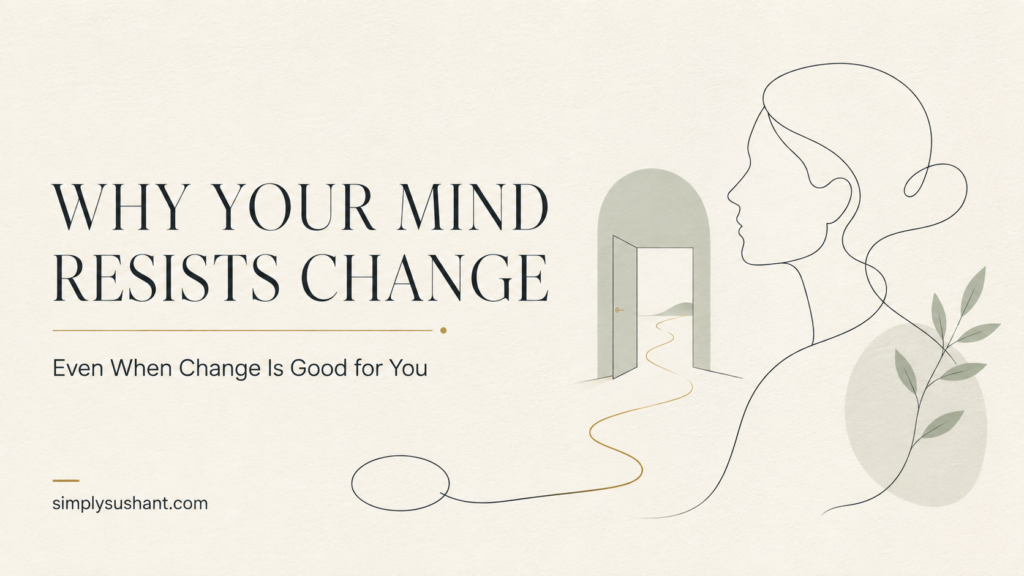
Eventually, the thing that once required enormous effort begins to feel normal. The unfamiliar path becomes the familiar route.
That is how lasting transformation often happens—not through one heroic decision, but through small moments in which you gently prove to your mind that change is possible.